
Beyond Self-Assessment, Towards a Culture of Quality
The introduction of the School Quality Assessment and Assurance Framework (SQAAF) by CBSE marks a significant shift in how schools approach excellence. It moves the conversation beyond academic results and compliance, encouraging schools to build systems that consistently support quality education, effective governance, and continuous improvement.
Yet, one misconception continues to surface across schools—SQAAF is often viewed as just another self-assessment exercise.
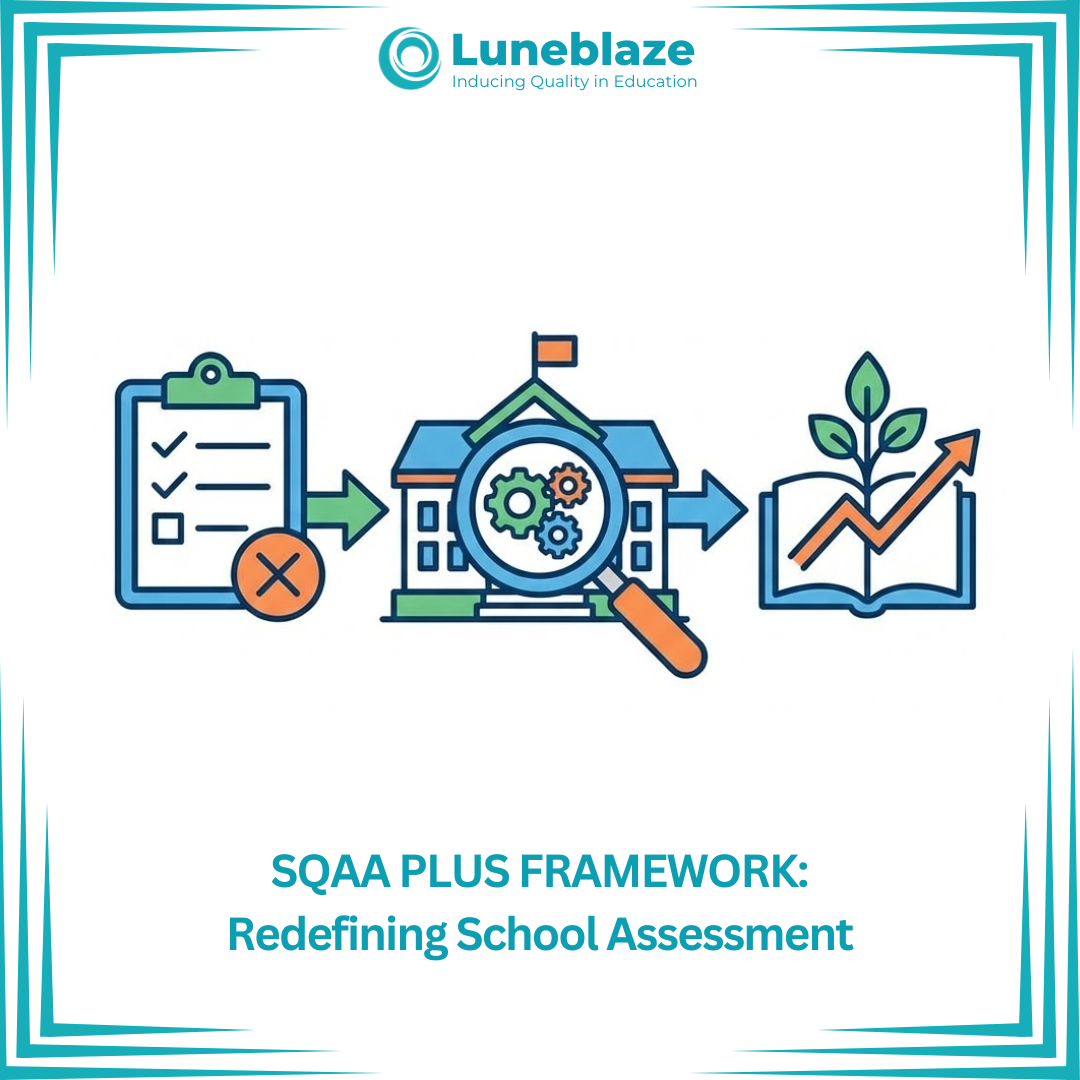
In reality, self-assessment is only one component of a much larger framework. The true purpose of SQAAF is to help schools establish, strengthen, and sustain quality systems that become an integral part of their daily functioning.
For principals, this distinction is important. Because how you understand SQAAF determines how your school implements it. SQAAF Is Not an Event—It's a Way of Running a School Many quality initiatives begin with enthusiasm but gradually become annual tasks that are revisited only when required. SQAAF is designed differently. It encourages schools to embed quality into everyday practices rather than treating it as a periodic exercise. From planning and implementation to review and improvement, every process within the school should contribute to building a stronger institution. When quality becomes part of the school's culture, assessment naturally becomes a reflection of the systems already in place—not a separate activity that demands last-minute preparation. Self-Assessment Is the Starting Point, Not the Destination The word self-assessment often creates the impression that SQAAF is primarily about evaluating where a school stands. While reflection is undoubtedly important, the framework goes much further. An effective self-assessment should answer questions such as: Where are we performing well? Which systems need strengthening? What improvements should we prioritise? How do we measure progress over time? The real value of SQAAF lies not in identifying gaps, but in creating structured action plans that address them. Schools that truly benefit from SQAAF use self-assessment as a tool for informed decision-making, not as the final objective. Quality Is Built Through Systems, Not Individual Efforts Every successful school has dedicated teachers, committed coordinators, and visionary leaders. But sustainable excellence cannot depend solely on individuals. People may change, responsibilities may shift, and leadership may evolve. What ensures continuity is a strong institutional system. SQAAF encourages schools to develop processes that remain consistent regardless of personnel changes. Clear policies, defined responsibilities, documented procedures, regular reviews, and evidence-based practices help transform individual efforts into institutional excellence. When systems become stronger, quality becomes sustainable. The Principal Is the Architect of School Quality No framework can create quality on its own. It is the leadership that gives direction to every policy, process, and practice within a school. A principal's role under SQAAF extends far beyond supervision. It involves creating a shared vision for quality, encouraging collaboration, promoting accountability, supporting professional growth, and ensuring that continuous improvement becomes part of the school's culture. When the leadership believes in quality as a continuous journey, the entire school community begins to work towards the same goal. Quality Cannot Be Built in Isolation One of the strongest messages within SQAAF is that quality is everyone's responsibility. It cannot rest with a single coordinator, one committee, or a small administrative team. Teachers, academic coordinators, administrative staff, support teams, students, parents, and school leadership all contribute to creating an effective learning environment. The principal's responsibility is to ensure that this shared ownership is understood across the institution. When every stakeholder understands their role in maintaining quality, implementation becomes more meaningful and sustainable. Documentation Is a Reflection of Good Practices One of the most visible aspects of SQAAF is documentation. Unfortunately, documentation is sometimes perceived as paperwork created solely for assessment purposes. In reality, documents serve a much greater purpose. They capture institutional practices, record decisions, demonstrate implementation, and provide evidence for continuous review. Good documentation does not create quality—it reflects quality. Schools that focus first on building effective systems naturally develop stronger documentation because it becomes a record of work that is already being carried out. Continuous Improvement Is the Heart of SQAAF Every school has strengths. Every school also has areas that can improve. SQAAF does not expect institutions to achieve perfection overnight. Instead, it encourages schools to regularly reflect, identify opportunities, implement improvements, and evaluate their progress. This mindset transforms quality from a one-time achievement into an ongoing institutional practice. The question is no longer: "Are we ready for assessment?" Instead, it becomes: "How can we become better than we were yesterday?" That shift in thinking defines the true spirit of SQAAF. SQAAF Creates Long-Term Value for Schools Schools that embrace SQAAF as a quality framework experience benefits that extend well beyond assessment. They develop: More structured institutional planning. Stronger governance and accountability. Better coordination across departments. Greater consistency in school processes. Improved decision-making through regular review. Enhanced stakeholder confidence. A stronger foundation for sustainable growth. Ultimately, these improvements contribute to what matters most—a better learning experience for every child. Preparing for SQAAF Means Preparing the School for the Future Education continues to evolve, bringing new expectations for schools, leaders, teachers, and learners. Frameworks like SQAAF encourage schools to become more reflective, responsive, and future-ready. For principals, this means shifting the focus from simply meeting requirements to strengthening the institution itself. When schools invest in quality systems today, they become better equipped to adapt to tomorrow's educational challenges. That is the lasting value of SQAAF. Every principal aspires to build a school that delivers meaningful learning experiences, nurtures every learner, empowers educators, and earns the trust of its community. SQAAF provides a structured pathway towards that vision—but only when it is understood in its true essence. It is not just a self-assessment framework. It is a framework for building quality systems. It is a framework for institutional excellence. It is a framework for continuous improvement. And above all, it is a framework that encourages schools to make quality an everyday practice rather than an occasional objective. Schools that embrace this philosophy don't prepare for SQAAF—they simply live it. How Luneblaze Supports Schools on Their SQAAF Journey Implementing SQAAF effectively requires schools to bring together policies, processes, documentation, evidence, reviews, and continuous improvement in a structured manner. Managing all of these manually can become challenging as schools progress in their quality journey. Luneblaze simplifies this process through its AI-enabled SQAAF platform, helping schools organize documentation, streamline evidence management, monitor implementation, conduct readiness assessments, and generate progress reports—all within a single ecosystem. Rather than viewing SQAAF as a one-time exercise, Luneblaze enables schools to build and sustain quality systems that support continuous institutional growth, allowing principals and school leaders to focus on what matters most—creating better learning environments for every student.