
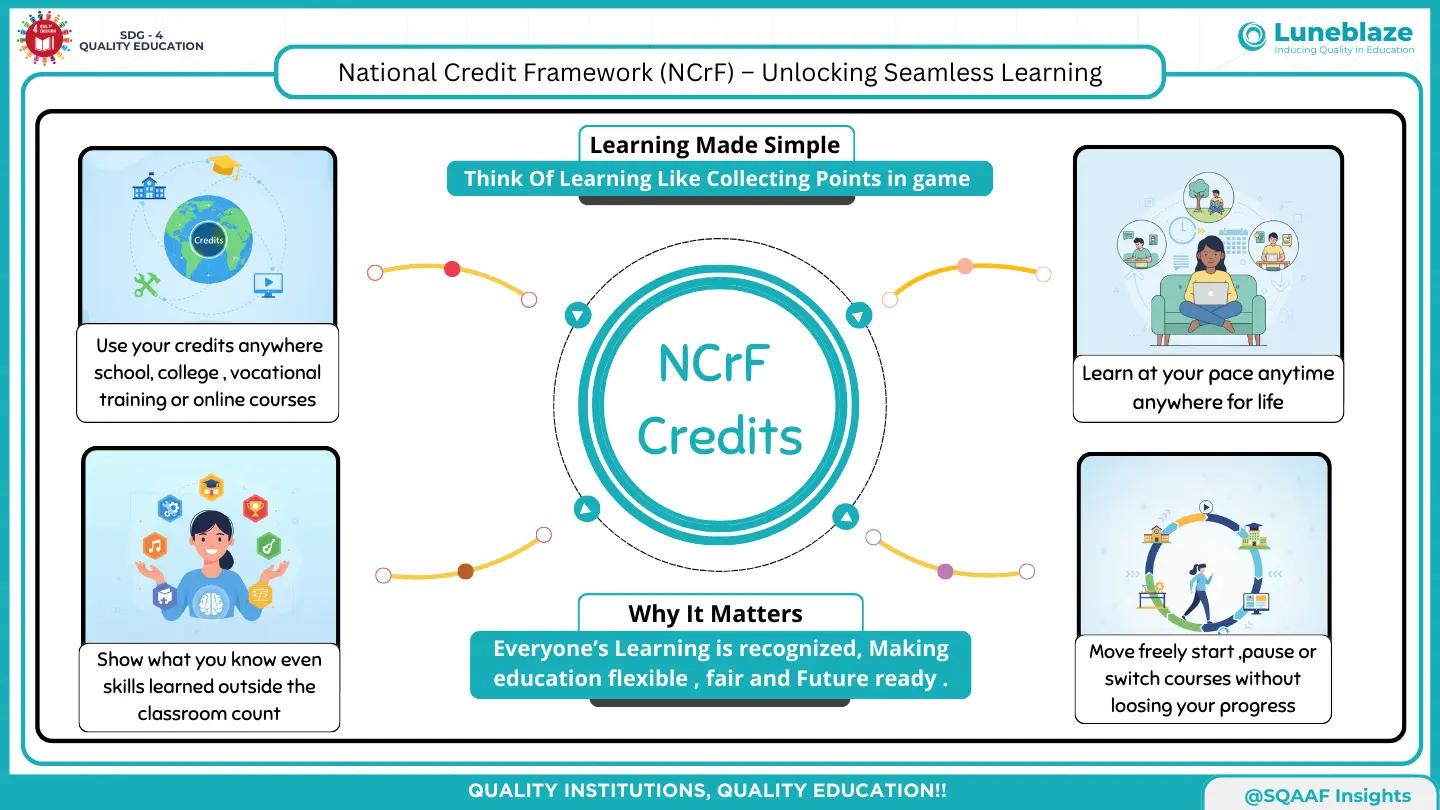
Imagine a learning ecosystem where a student can smoothly shift between vocational training and mainstream academics, stack credits across schooling and college, or re-enter education after work experience—with all learning, whether formal, informal, or experiential, counted and credited. This is the transformative vision of the National Credit Framework (NCrF), a landmark initiative designed to revolutionize how India perceives education, skill, and learning outcomes.
Conceived under the National Education Policy (NEP) 2020, the NCrF creates a unified credit system that integrates school education, higher education, and vocational training into a single, flexible, learner-centric ecosystem. It breaks down barriers between academic and vocational education and formal and experiential learning, supporting the learner's journey through mobility, flexibility, and lifelong learning.
What is the National Credit Framework?
The National Credit Framework (NCrF) is a comprehensive, unified credit system developed by a high-level inter-ministerial committee comprising UGC, AICTE, CBSE, NCERT, NIOS, NCVET, and others. It is designed to:
Assign, accumulate, transfer, store, and redeem credits across educational and skilling domains.
Seamlessly integrate academic, vocational, and experiential learning.
Eliminate rigid boundaries between streams and disciplines.
Enable Multiple Entry and Exit (ME-ME) options across educational stages.
Provide a single credit currency via the Academic Bank of Credits (ABC).
With 1 credit equal to 30 notional learning hours, the NCrF standardizes credit assignment across institutions and recognizes all forms of learning—whether classroom instruction, skill training, internships, online modules, or hands-on experience.
Key Features of NCrF
Unified & Inclusive
NCrF acts as an umbrella framework for all qualification types:
NHEQF (Higher Education)
NSEQF (School Education)
NSQF (Vocational Education)
This alignment ensures equivalence, portability, and recognition of qualifications across the education ecosystem.
Credit Mobility & Flexibility
Learners can:
Transfer credits across institutions and learning modes.
Exit and re-enter at various levels with credit continuity.
Pursue education alongside work, skill development, or informal learning.
Personalized & Lifelong Learning
The framework:
Supports Recognition of Prior Learning (RPL) for skills acquired informally.
Enables accelerated progression for gifted students.
Encourages learners of all ages to upskill, reskill, or pursue new interests.
Holistic Creditisation
Credits can be earned through:
Academics (school, college, university)
Vocational education, apprenticeships, internships
Projects, extracurriculars, sports, arts, and community service
Online and blended learning
Relevant work experience
Why India Needs the NCrF
India is home to one of the world’s youngest populations. To leverage its demographic dividend, education must:
Be skill-integrated, outcome-based, and globally aligned.
Recognize non-linear learning paths and multiple modes of knowledge acquisition.
Promote academic-vocational parity and cater to dynamic industry needs.
NCrF is the structural reform that answers these challenges by creating a system where all learning counts, ensuring no learner is left behind.
Implementation Roadmap
The NCrF will be implemented via:
Academic Bank of Credits (ABC) for storage and redemption.
Integration with DigiLocker for verifiable, portable credentials.
Institutional autonomy to define credit structures within the framework.
Sectoral and regulator-specific implementation guidelines from UGC, AICTE, NCERT, etc.
Alignment with NEP 2020 and SQAAF
The framework directly supports:
NEP’s goals of multidisciplinarity, flexibility, and skill integration.
SQAAF’s focus on student-centric education, innovation, and institutional effectiveness.
By unifying learning across school, higher education, and skills training, NCrF operationalizes NEP’s vision and empowers schools to align their curriculum, pedagogy, and governance accordingly.
Conclusion: Towards a Future-Ready India
The National Credit Framework is more than a policy—it’s a mindset shift toward valuing every learner’s journey. By creditising diverse forms of learning, NCrF personalizes education, removes hierarchy between knowledge types, and builds a resilient, flexible, and empowered education ecosystem.
Whether you are a student, teacher, parent, or policymaker, NCrF invites everyone to embrace education as a continuous, inclusive journey. It’s a giant leap toward bridging aspiration with opportunity.