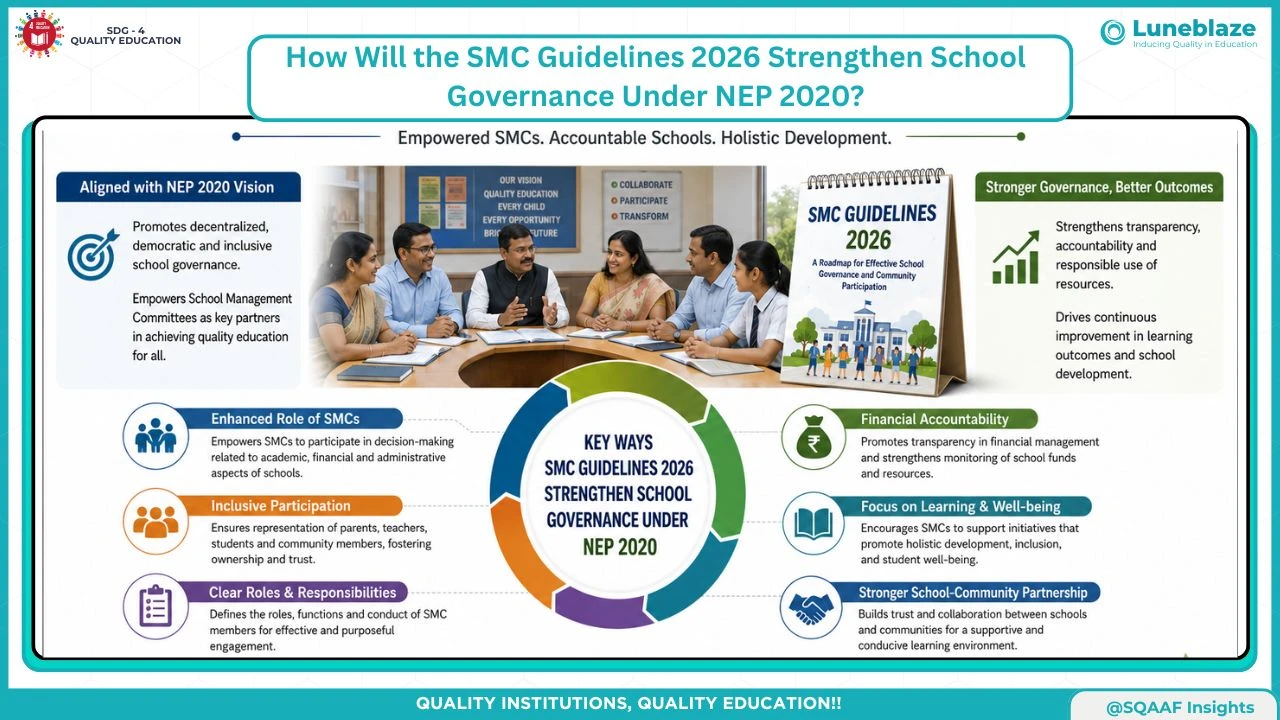
“The SMC Guidelines 2026 mark a significant shift toward participatory school governance—bringing parents, educators, communities, and administrators together to build more accountable, inclusive, and quality-driven schools.”
By redefining the structure and responsibilities of School Management Committees (SMCs), the Government aims to create a stronger foundation for transparency, safety, planning, and educational excellence across schools in India.
What Are the SMC Guidelines 2026?
Launched by Union Education Minister Dharmendra Pradhan, the SMC Guidelines 2026 are a comprehensive framework designed to strengthen school governance and community participation in alignment with the goals of the National Education Policy (NEP) 2020.
The guidelines redefine how School Management Committees function by introducing more structured governance mechanisms, stronger accountability systems, improved planning processes, and greater involvement of parents and local communities in school development.
Under the revised framework, SMCs are expected to move beyond administrative formalities and become active drivers of school improvement, student welfare, infrastructure development, and community engagement.
Core Features of the SMC Guidelines 2026
1. Parent-Centric Representation
75% of SMC members must be parents or guardians.
50% reservation for women ensures inclusive and balanced participation.
Encourages stronger parental involvement in school governance.
2. Unified School Management Structure
A single SMC will manage schools from Balvatika to Class 12.
SMCs must be formed within one month of the academic session.
3. Inclusive Committee Composition
The committee will include:
Parents
Teachers
Principals
Local authorities
Education experts
This ensures collaborative and balanced decision-making.
4. Structured Monitoring and Meetings
Committee size will vary according to student enrollment.
Mandatory monthly meetings will ensure regular review and monitoring.
5. Financial and Infrastructure Oversight
SMCs can directly manage civil works up to ₹30 lakh.
Higher-value projects will require public tendering procedures.
6. Development Planning and Social Audits
Schools must:
Prepare a 3-year School Development Plan
Conduct yearly updates
Implement social audits for transparency and improvement
7. Student Safety and Inclusion
Mandatory provisions include:
Safety drills
POCSO awareness initiatives
Support systems for children with special needs
Alignment with School Quality and Governance Goals
Governance and Leadership
The guidelines strengthen decentralized governance by ensuring regular monitoring, accountability, and participatory decision-making.
Community Participation
By placing parents at the center of governance, schools become more responsive to student and community needs.
Infrastructure and Resource Management
Empowered SMCs can address infrastructural requirements more efficiently while ensuring financial transparency.
Student Welfare and Safety
The framework prioritizes safe, inclusive, and supportive learning environments for all learners.
Institutional Planning and Improvement
Long-term planning and yearly reviews encourage schools to focus on continuous improvement rather than short-term compliance.
Transparency and Accountability
Regular evaluations by Education Officers promote evidence-based governance and better institutional performance.
Why Were the SMC Guidelines 2026 Introduced?
The Government introduced the SMC Guidelines 2026 to strengthen grassroots participation in school governance and align educational administration with the vision of NEP 2020.
The revised framework addresses challenges such as:
Limited parental involvement
Weak governance systems
Inconsistent planning practices
Lack of accountability mechanisms
By introducing clearer structures and responsibilities, the guidelines aim to create schools that are more transparent, inclusive, and quality-focused.
Conclusion
The SMC Guidelines 2026 represent a major step toward building stronger, more accountable, and community-oriented schools in India.
By empowering parents, strengthening governance systems, improving institutional planning, and prioritizing student safety, the framework lays the foundation for more effective school management under NEP 2020.
For schools aiming to improve institutional effectiveness, stakeholder participation, and long-term development, the SMC Guidelines 2026 are not just policy reforms—they are a roadmap toward sustainable educational excellence.