
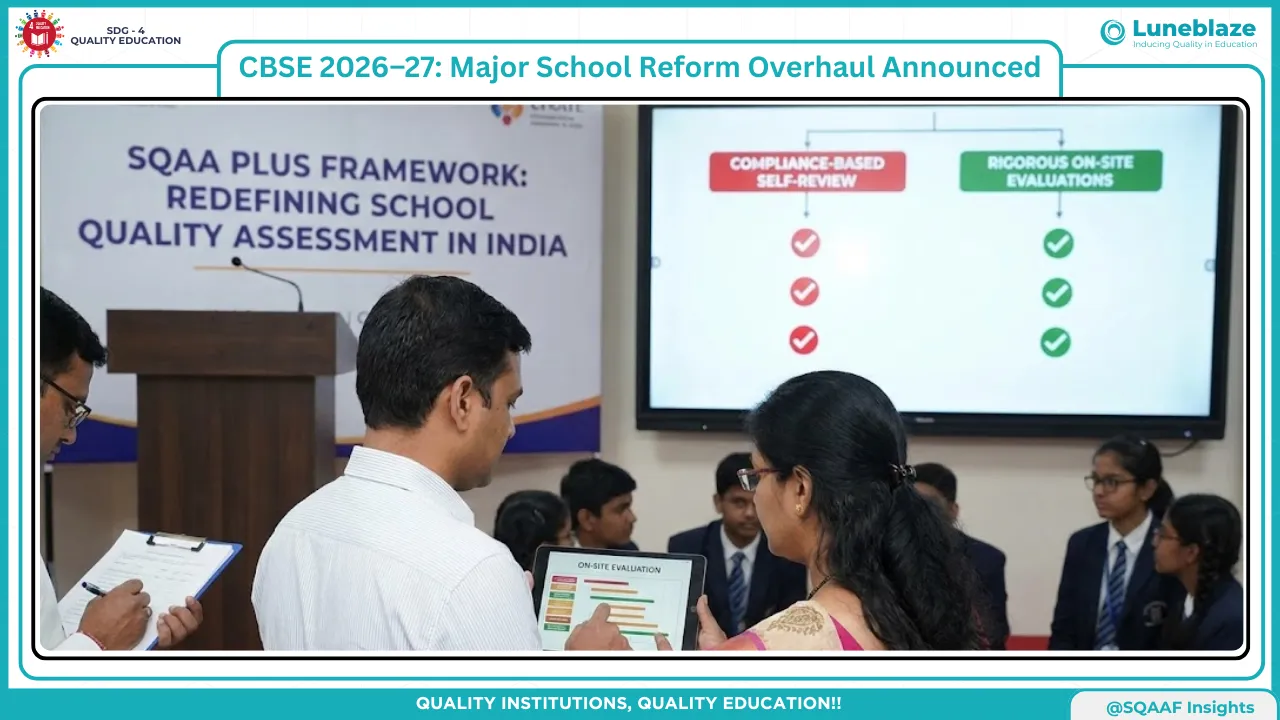
In a significant shift from compliance-based self-reviews to rigorous on-site evaluations, the SQAA Plus Framework aims to strengthen school quality assurance across multiple domains for better learning outcomes.
By emphasizing evidence-based inspections, real-time assessments, and categorical ratings, the SQAA Plus Framework seeks to elevate educational standards and accountability in CBSE-affiliated schools.
What Is the SQAA Plus Framework?
The SQAA Plus Framework is a revamped quality assurance model introduced by the Central Board of Secondary Education (CBSE) to strengthen how schools are evaluated across India. This new framework updates the existing School Quality Assessment and Assurance (SQAA) system by shifting away from largely self-evaluated compliance reports to a more inspection-led, field-oriented quality rating structure.
Under the traditional SQAA framework, schools conducted annual self-assessments on domains like curriculum, infrastructure, governance, and stakeholder satisfaction. While the self-review process helped initiate reflective practices, it often lacked robust third-party validation and real-time evaluation of institutional performance.
The SQAA Plus Framework upgrades this by introducing on-site inspections and multi-domain assessments performed by trained specialists, making quality assurance more credible, data-driven, and performance-focused.
Core Features of the SQAA Plus Framework
Inspection-Led Evaluations: Schools will undergo real-time, on-site inspection rather than relying solely on written self-reports.
Multi-Domain Rating: Institutions will be assessed across key quality areas including academics, governance, infrastructure, leadership, inclusivity, and student well-being.
Categorical Grading: Schools will receive performance grades ranging from A+ to C, offering a clear snapshot of institutional health and areas for improvement.
Data-Driven Quality Assurance: Evidence-based evaluations backed by inspection experts enable deeper insights into school performance gaps and progress opportunities.
Phased Rollout: The pilot will begin with around 500 centrally governed schools including those under Kendriya Vidyalaya Sangathan, Jawahar Navodaya Vidyalaya Samiti, and Eklavya Model Residential Schools.
Why Was SQAA Plus Introduced?
The primary goal of introducing the SQAA Plus Framework is to build a stronger, more accountable quality assurance system that goes beyond paper-based self-evaluation. CBSE officials noted that an inspection-led model would provide field-verified insights into on-ground practices, enabling richer data for improvement planning and governance decisions.
By engaging specialized inspection teams and third-party consultants, the framework ensures more consistent, transparent, and credible assessments of school operations and outcomes.
Key Benefits of the SQAA Plus Framework
1. Enhanced Accountability and Transparency
With on-site assessments conducted by trained evaluators, schools face a more objective review process that minimizes subjectivity and strengthens stakeholder trust.
2. Evidence-Based Quality Improvement
The framework’s emphasis on inspection and performance metrics encourages schools to collect better evidence of practices and outcomes, helping administrators identify precise improvement pathways.
3. Multi-Dimensional Evaluation
Rather than focusing solely on academic results or compliance checklists, SQAA Plus evaluates a comprehensive set of domains—governance, student well-being, inclusivity, and leadership—supporting holistic school development.
4. Clear Performance Ratings
Grades like A+, A, B+ and C simplify interpretation of quality levels, enabling schools to benchmark performance against peers and plan strategic enhancements.
5. Support for Continuous Growth
By revealing strengths and gaps with detailed insights from inspection reports, schools can refine policies, instructional design, and infrastructure planning.
How SQAA Plus Builds on SQAA Foundations
The earlier SQAA system was designed as a self-reflection and improvement tool, requiring schools to complete annual self-assessments across various quality parameters using an online portal.
While this helped schools identify internal strengths and weaknesses, the absence of structured, empirical evaluation limited the depth of quality assurance. SQAA Plus addresses this by adding an external validation layer that emphasizes evidence verification, observational review, and direct engagement with school practices.
What This Means for Schools and Students
For institutions, the SQAA Plus Framework presents an opportunity to build stronger internal processes and elevate standards based on comprehensive feedback from real-world observations. For students and parents, it introduces greater clarity on school quality and helps ensure that a school’s reported achievements are grounded in verified performance.
In essence, SQAA Plus is a major stride toward improving school accountability and quality assurance across India, with the potential to positively influence the overall educational experience and institutional effectiveness in the years to come.