“Where does your school stand today, and where does it aspire to be tomorrow?”
This is a question that every school leader, educator, and stakeholder must reflect upon. In a rapidly evolving educational landscape, it’s not enough to simply exist within the system. Schools must continuously strive to measure their progress, adapt to change, and foster environments where learners thrive holistically. That’s precisely where the School Quality Assessment and Assurance Framework (SQAAF) comes in.
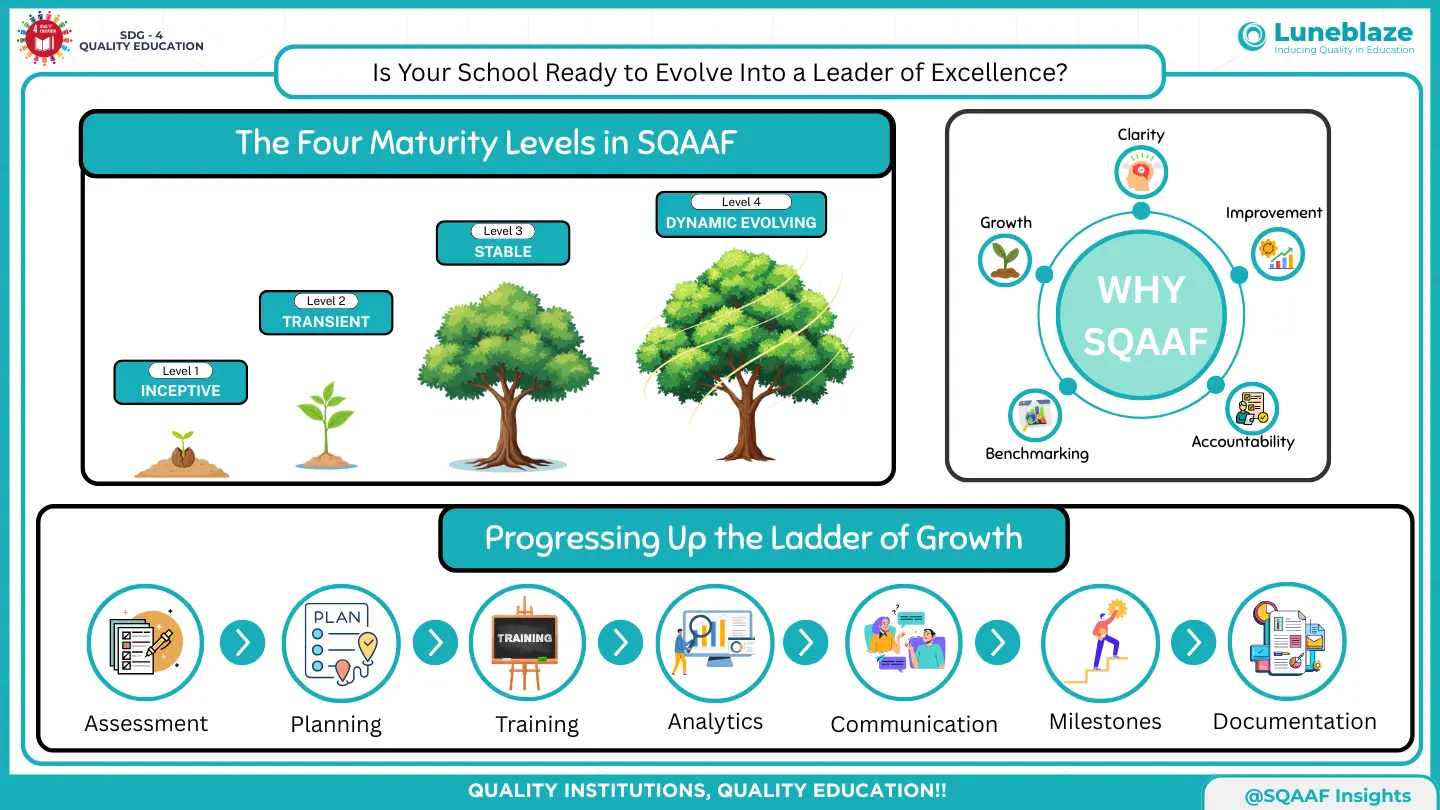
At the heart of SQAAF lies the concept of maturity levels—a structured progression model that helps schools assess where they are on their journey toward excellence. Understanding these maturity levels is not just about compliance; it’s about building a culture of growth, accountability, and innovation. Let’s explore how these levels work, why they matter, and what they mean for the future of school development. Maturity levels are benchmarks of institutional growth. They describe how effectively a school is implementing SQAAF standards across domains like curriculum, pedagogy, assessment, inclusivity, infrastructure, leadership, governance, and community engagement. The framework uses four maturity levels that reflect increasing consistency, documentation, and innovation. They provide both a qualitative description (from “inceptive” to “dynamic evolving”) and a quantitative score (Level I = 1 point, Level IV = 4 points). This is the entry-level stage where schools are in the early stages of aligning themselves with SQAAF standards. Practices may exist in parts but are not yet systematized. Policies are either absent or rudimentary, processes are inconsistent, and evidence to show compliance is minimal. Schools here are fulfilling statutory requirements but have not yet developed structured mechanisms for improvement. Indicators of the Inceptive Level: Only basic statutory norms are met. Documentation is either missing or very limited. Processes happen occasionally, without regular monitoring. Stakeholder engagement is minimal or reactive. At this stage, schools need clarity, direction, and consistent effort to build a strong foundation. Schools at this stage begin to move beyond mere compliance. They have policies drafted, some systems in place, and early efforts toward regular implementation. Processes are visible but still evolving. Monitoring happens occasionally, and while there are attempts at inclusivity and innovation, consistency and integration are not yet fully achieved. Indicators of the Transient Level: Policies and processes are partially developed. Some documentation exists, though evidence is scattered. Attempts at using feedback are made but not systematic. Technology integration or stakeholder participation is limited to certain areas. The Transient level is a sign of growth—schools are beginning to “connect the dots” but need more discipline and systematic follow-through. At this maturity level, schools demonstrate structured, consistent, and documented practices across domains. Policies are not just drafted but also implemented. Systems are reviewed regularly, and decisions are data-informed. Inclusivity and equity are integrated into daily functioning. There is transparency in governance, and stakeholder feedback is valued and used. Indicators of the Stable Level: Well-documented policies and regular implementation. Evidence-based teaching-learning and assessment practices. Stakeholder engagement through structured feedback mechanisms. Safety, inclusivity, and sustainability are embedded in processes. Transparent communication systems are in place. The Stable stage indicates reliability and accountability. Schools here are well-organized, with systems that deliver consistent outcomes. This is the highest maturity level within SQAAF—where schools evolve into leaders and role models for others. At this stage, schools demonstrate continuous improvement, benchmarking, and innovation. They not only meet standards but also set new ones. Best practices are documented and shared; leadership fosters a culture of research, creativity, and sustainability. Indicators of the Dynamic-Evolving Level: Benchmarking with national and international standards. Continuous professional development and research-driven practices. Advanced use of ICT across teaching and administration. Deep-rooted community engagement and partnerships. Sustainable and eco-friendly practices embedded in daily functioning. Recognition for innovative and exemplary practices. This level represents the vision of SQAAF—schools that are resilient, forward-looking, and inspirational for others. Maturity levels are not about ranking schools against each other. Instead, they are about giving schools a roadmap for growth. Here’s why they are crucial: Clarity of Direction — Schools understand exactly where they stand and where they need to go. Structured Growth — Levels ensure systematic improvement instead of ad-hoc fixes. Accountability — Schools can show evidence to stakeholders about progress. Benchmarking — Schools can compare their growth with standards, not competitors. Continuous Improvement — Excellence is seen as an ongoing journey, not a one-time achievement. Progressing through maturity levels requires intentional, sustained action. Here are some strategies: Self-Assessment: Use the SQAAF framework to map current practices and score against standards. Develop a Self-Improvement Plan: Create domain-wise plans with clear timelines, responsibilities, and measurable indicators. Invest in Capacity Building: Train teachers and staff regularly to align with modern pedagogical and administrative practices. Use Data Smartly: Collect, analyze, and act on feedback from students, parents, and staff. Strengthen Communication: Establish transparent channels with all stakeholders. Celebrate Milestones: Acknowledge each step forward to keep motivation high. Document Practices: Maintain records that demonstrate not just compliance but also innovation and impact. It is important to see maturity levels not as labels, but as milestones. A school may be Inceptive in one domain and Stable in another—that’s perfectly natural. The goal is not perfection but progress. SQAAF maturity levels push schools to shift from being institutions that merely deliver education to become vibrant communities that create impact. This cultural shift benefits everyone: Students get better opportunities for holistic development. Teachers find professional growth and satisfaction. Parents and communities trust schools more. Society benefits from responsible, future-ready citizens. Take a moment and reflect—would you describe your school as Inceptive, Transient, Stable, or Dynamic-Evolving? SQAAF maturity levels are not about judgement; they are about empowerment. They help schools identify where they are, chart where they want to go, and design a realistic roadmap to get there. The journey is continuous, but every step upward makes a difference—not only for the institution but for the lives it touches. So, let’s return to our opening question: How mature is your school’s journey toward excellence? The answer lies in where you are today and how committed you are to moving forward tomorrow.What Are Maturity Levels in SQAAF?
The Four Maturity Levels in SQAAF
1. Inceptive (Level I): The Starting Point
2. Transient (Level II): The Developing Stage
3. Stable (Level III): The Established Stage
4. Dynamic-Evolving (Level IV): The Aspirational Stage
Why Do Maturity Levels Matter?
How Can Schools Move Up the Maturity Ladder?
The Bigger Picture: SQAAF as a Culture of Growth
Where Does Your School Stand Today?