Imagine standing at the crossroads of progress in education, where each path represents a different developmental stage of your school’s growth. The journey towards excellence is mapped out with clear indicators, markers, and goals, helping you navigate your school’s performance level and guide it towards continual improvement. This process involves three key components: Performance Levels, Performance Indicators, and Rubrics. Together, they answer some essential questions:
How will the school be assessed on each standard?
The school will be assessed through clearly defined performance indicators associated with each standard. These indicators outline specific actions and practices that demonstrate the school’s progress on each standard. Using a rubric, these performance indicators are linked to four performance levels (1 to 4), providing a structured way to evaluate how well the school meets the expectations at each stage of development.
Each performance level represents a degree of adherence to the standard, from foundational to exemplary. Schools at level 1 may need improvement, while level 4 reflects best practices. The assessment includes self-evaluation, external reviews, and evidence-based documentation, offering a clear roadmap for continuous improvement.
How can the school determine where it stands on each standard to foster continuous improvement?
To determine its standing, the school must compare its current practices against the performance indicators outlined in the rubric. This involves systematically reviewing key aspects of school functioning, including student outcomes, teacher effectiveness, and overall institutional processes.
By gathering concrete evidence such as student data, teacher assessments, and feedback from the school community, the school can identify its existing performance level. This self-assessment process not only highlights areas requiring improvement but also establishes a baseline, guiding the school toward continuous progress and better educational outcomes.
How can a school determine the appropriate performance level it should aim for?
A school can determine the appropriate performance level by evaluating its current strengths, weaknesses, and available resources. This involves assessing its standing on each standard using performance indicators and levels, allowing it to set a goal that aligns with its capabilities and aspirations.
The school should also consider its long-term vision, the extent of improvement required, and feedback from key stakeholders such as teachers, students, and parents. By balancing ambition with practicality, it can select a performance level that fosters growth while remaining achievable within its existing resources and timeframe.
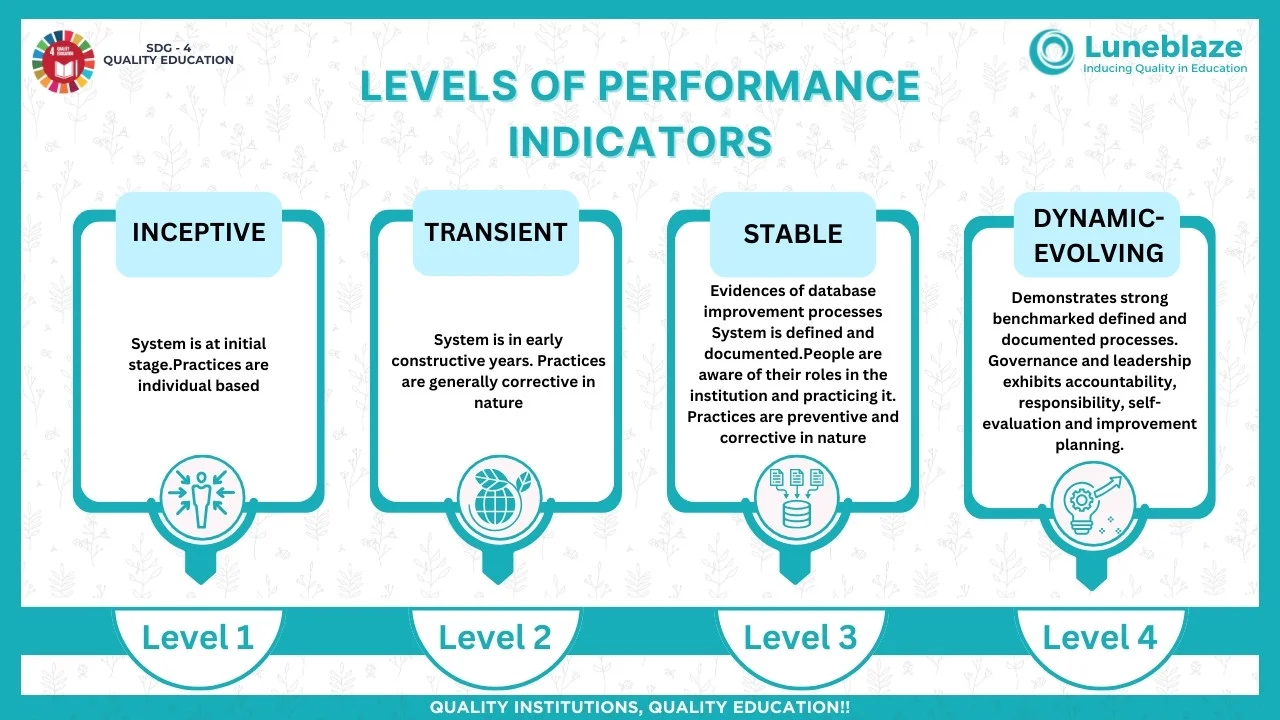
To facilitate the assessment of a school’s performance on various standards, four performance levels have been defined. These levels are represented on a scale of 1 to 4, where Performance Level IV represents the highest achievement and Performance Level I indicates the lowest. Performance levels not only reflect where the school stands in its developmental journey but also outline the path forward. As the school progresses, it moves from lower performance levels to higher ones. Performance Level IV, the highest, can only be achieved if the school fulfills the requirements of the preceding levels.
Each performance level is accompanied by observable actions and practices, referred to as performance indicators, which are specific to each standard or benchmarking statement. These indicators serve as tangible benchmarks that define the school’s progress, offering a structured way to measure and evaluate performance against established expectations. Schools can use these indicators to identify strengths, address gaps, and develop targeted strategies for improvement.
When performance levels and indicators are clearly specified for each standard, they collectively form what is known as a "Rubric"—a comprehensive scoring guide that aids in systematic assessment. This rubric not only provides clarity on the school’s current standing but also outlines the necessary steps to advance to the next level. By using the rubric as a reference, schools can establish a culture of continuous improvement, ensuring that their efforts are aligned with best practices and long-term educational goals.
The Four Performance Levels
In the framework of the School Quality Assessment and Assurance (SQAA), the performance levels are categorized as follows:
1. Performance Level-IV (Dynamic-Evolving): The highest level, representing a school that has achieved a state of dynamic evolution, where continuous improvement and adaptability are integral to its functioning.
2. Performance Level-III (Stable): Denotes a school that is stable, demonstrating a consistent level of performance across various standards.
3. Performance Level-II (Transient): A school at this level is in transition, making progress but still facing challenges in achieving full stability.
4. Performance Level-I (Inceptive): The starting point, indicating a school that is in its initial stages of development and requires focused efforts to establish foundational practices.
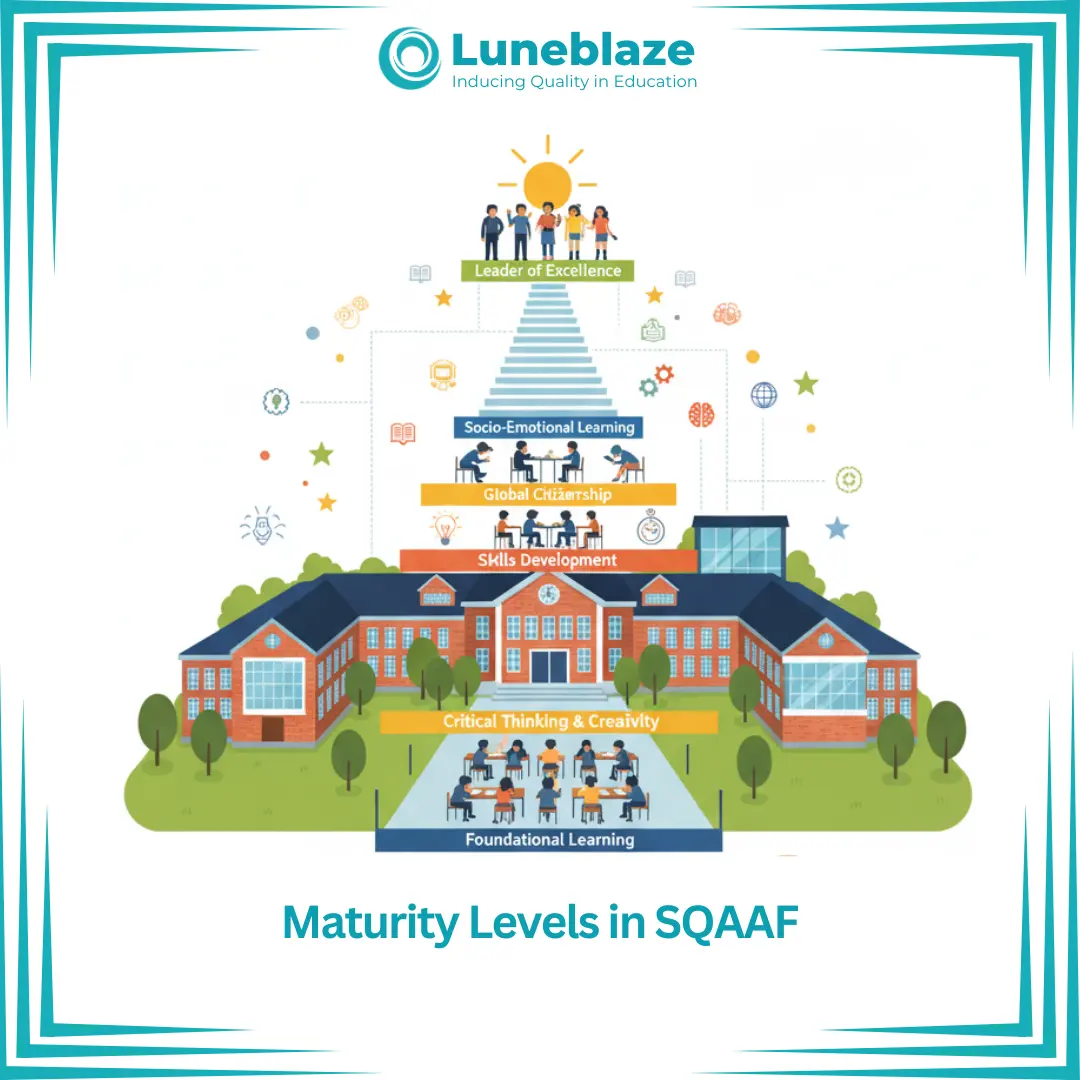
These four levels serve as clear markers for understanding the maturity of a school and the steps it must take to progress. Schools can use these levels as a reference to assess their current developmental stage and create action plans for growth. However, it’s important to note that while the performance indicators serve as a guide, not all indicators will apply to every school. Each institution must tailor its improvement plan based on its unique context and needs.
To support these efforts, Luneblaze provides a comprehensive AI-enabled end-to-end solution to schools for all their accreditation criteria needs, be it documents & evidence creation, self-assessment filing support on the CBSE SQAAF portal, faculty trainings, audits, and consultancy support.
With the help of Luneblaze’s AI-enabled solutions, institutions can organize and manage all their data related to accreditation and assessments like SQAAF for schools.
Together, let’s raise educational standards. Partner with Luneblaze for SQAAF success. Reach out: sqaa@luneblaze.com.