Walk into a vibrant school corridor on a weekday afternoon. A group of teachers gathers around a smart board, actively discussing differentiated instruction techniques. Down the hall, the principal is engaged in a session on adaptive leadership, while housekeeping staff participate in a short module on school safety. Across the campus, learning is happening—not just in classrooms, but among the educators themselves. This is what a school deeply engaged in Capacity Building looks like. It’s alive, evolving, and aligned with a larger vision: improving learning outcomes by continuously upskilling its stakeholders.
In the context of the School Quality Assessment and Assurance Framework (SQAAF) introduced by CBSE, Capacity Building Programs (CBPs) have taken center stage. These structured learning experiences are not just a compliance requirement—they are the heartbeat of a school committed to excellence. When thoughtfully planned, delivered, and documented, CBPs create a culture of professional growth that directly influences student success.
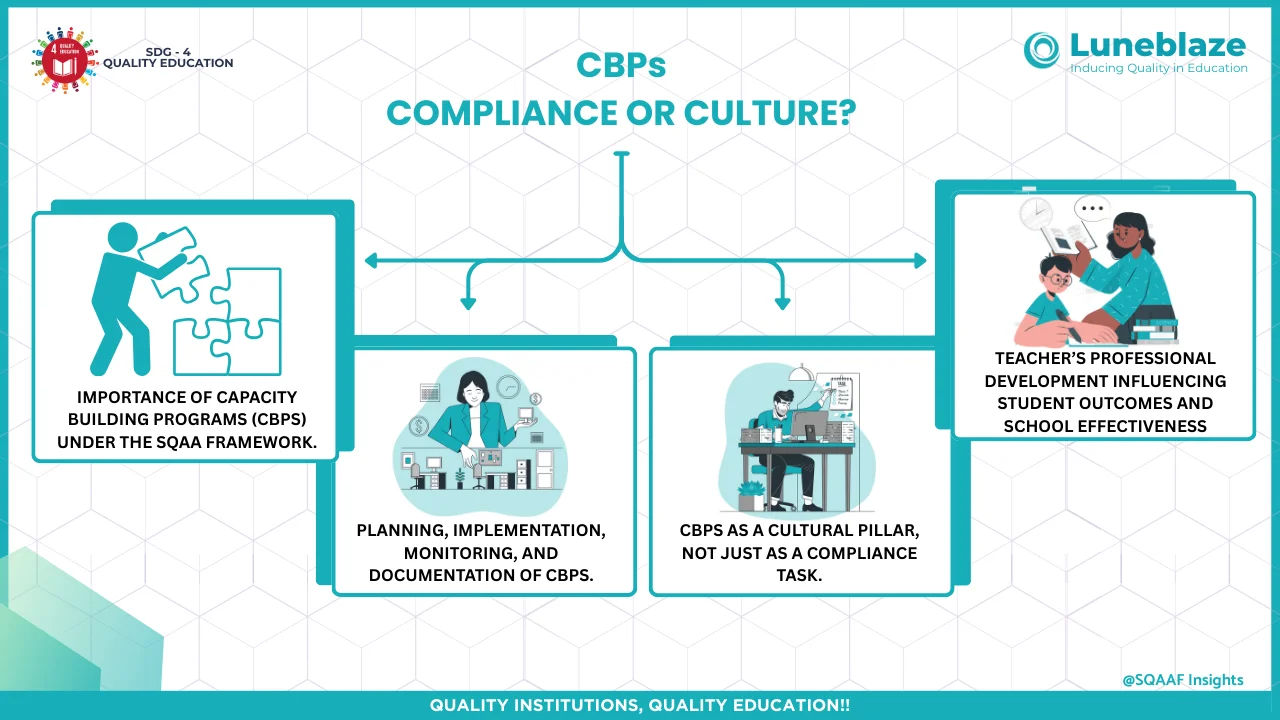
Understanding the Role of CBPs in SQAAF Capacity Building Programs are defined as targeted initiatives aimed at enhancing the knowledge, skills, and competencies of school stakeholders—ranging from teachers and school leaders to admin, housekeeping staff, and even parents. According to the latest CBSE SQAAF handbook, professional development is considered a crucial benchmark under various domains, especially under the "Human Resources" and "Leadership" focus areas. Schools are expected to identify the professional development needs of their staff and design CBPs that respond to those needs. More importantly, these programs must be regularly implemented and their impact should be visible in classroom practices and student performance. It is also clearly stated that all teachers must attend CBPs as mandated by the Board. This includes sessions related to subject content, pedagogical innovations, assessment strategies, and cross-disciplinary competencies like art integration, life skills, and inclusive practices. Creating Purposeful Professional Development Merely conducting CBPs is not enough. Schools must ensure that these programs are meaningful, relevant, and followed up with clear strategies for implementation. Teachers are expected to: Reflect on their learnings Document them through reports Incorporate key insights into their lesson plans Engage in collaborative discussions to improve practice For instance, when teachers attend CBPs on aligning classroom tasks with Learning Outcomes (LOs), the impact should be visible in how lesson objectives are framed, how tasks are designed, and how student understanding is assessed. Furthermore, CBSE encourages schools to organize CBPs not just for teachers but for lab attendants, admin staff, non-teaching personnel, and even students and parents. This inclusivity reinforces the idea that professional development is a whole-school effort. Monitoring, Reviewing, and Reflecting Another significant expectation under the SQAAF framework is the regular monitoring and review of CBP implementation. This involves: Tracking participation: Ensuring that all staff members attend CBPs as per schedule. Reviewing application: Observing how learnings are integrated into daily practices. Providing feedback: Creating a non-threatening environment for discussion and reflection. Analyzing impact: Studying how CBPs influence learner outcomes and classroom effectiveness. Leadership plays a key role here. School leaders are expected to undergo CBPs themselves, particularly those focusing on curriculum planning, pedagogy, assessments, and managing change. These sessions help them guide their teams more effectively and foster a culture of continuous improvement. Documenting CBPs for SQAAF Self-Assessment As schools prepare for SQAAF self-assessment, maintaining thorough documentation of CBPs becomes crucial. This documentation serves two primary purposes: Evidence of compliance with CBSE’s quality benchmarks Reflection of the school’s commitment to building capacity at every level To avoid redundancies and ensure clarity, documentation should be categorized and labeled systematically. Schools should maintain records for: CBPs conducted for and attended by teachers, school leaders, students, admin and housekeeping staff, and parents CBPs covering key areas like curriculum, pedagogy, assessment practices, examinations, and art education CBPs focusing on latest pedagogical innovations, use of technology, and change management Reports on impact analysis, monitoring strategies, and implementation reviews Schools are expected to prepare the following documents as part of their SQAAF self-assessment: This concise but comprehensive documentation not only helps during assessment but also becomes a valuable internal resource for future planning. Making CBPs a Cultural Pillar One of the most powerful shifts schools can make is to view CBPs not as a checklist item but as a cornerstone of their institutional culture. When teachers look forward to their professional development sessions, when leaders model lifelong learning, and when even non-teaching staff feel engaged and valued through relevant CBPs—that’s when transformation begins. Here are a few ways schools can integrate CBPs into their core functioning: Align CBPs with school goals and academic calendars Create teacher-led learning communities where experiences from CBPs are shared Celebrate innovations and successes that emerge from professional development Use student feedback to assess the impact of CBPs on classroom experiences By focusing on relevance, collaboration, and reflection, CBPs can become one of the most powerful tools for institutional growth. In conclusion, as the education landscape continues to evolve, the need for dynamic, responsive, and effective professional development becomes even more urgent. SQAAF has rightly placed Capacity Building at the heart of its quality assurance model, reminding schools that continuous learning is not optional—it’s essential. Schools that embrace this approach don’t just meet standards—they set them. And as they do, their learners benefit the most. Capacity Building Programs, when thoughtfully executed, become more than a procedural requirement—they become a source of inspiration and innovation. With the right mindset, systems, and documentation in place, schools can use CBPs as a catalyst for change to achieve the holistic educational vision that SQAAF upholds. To support these efforts, Luneblaze provides a comprehensive AI-enabled end-to-end solution to schools for all their accreditation criteria needs, be it documents & evidence creation, self-assessment filing support on the CBSE SQAAF portal, faculty trainings, audits, and consultancy support. With the help of Luneblaze’s AI-enabled solutions, institutions can organize and manage all their data related to accreditation and assessments like SQAAF for schools. Together, let’s raise educational standards. Partner with Luneblaze for SQAAF success. Reach out: sqaaf@luneblaze.com
List of CBPs conducted, CBPs attended by teachers (subject-wise and theme-wise), CBPs for students and parents, CBPs for non-teaching and admin staff, CBPs for school leaders, reports on CBPs related to curriculum and pedagogy, CBPs on examinations and assessments, integration of technology in CBPs, implementation reviews, and impact analysis on teaching practices and learner outcomes.